Ballarat, VIC 3350
Debt Consolidation Ballarat
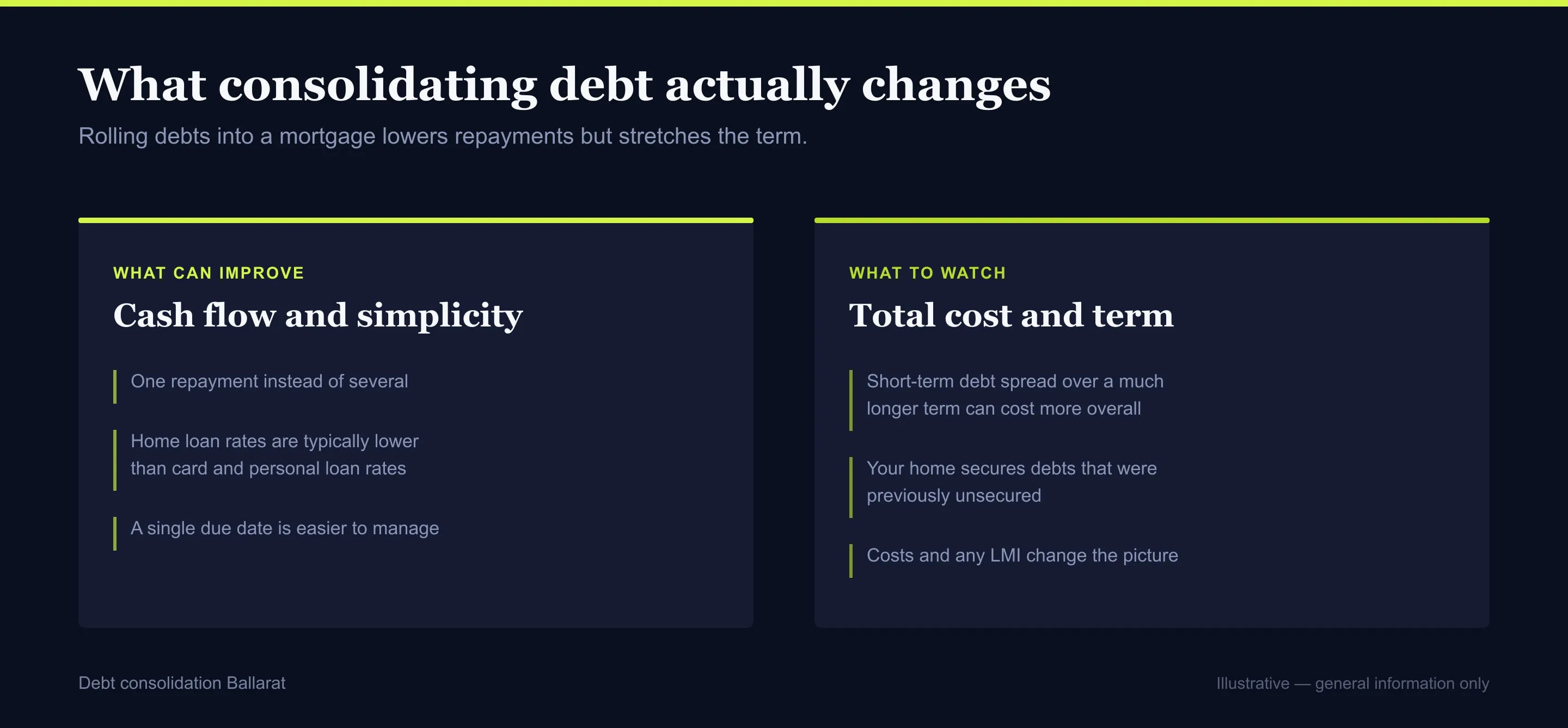
Rolling a card into your mortgage cuts the monthly repayment. It can also stretch a three-year debt across twenty-seven years, and you pay interest for every one of them. The monthly saving is real, the total cost often rises, and both numbers matter. We put them side by side.
What decides it is how long each debt had left to run. A car loan with two years on it and a card you were never going to clear behave completely differently once they are inside a mortgage, so we work from your actual balances and terms rather than an average.
What We Do When You Consolidate
We refinance your home loan to a larger amount and use the extra funds to pay out your other debts, so the credit cards, personal loan and car finance disappear and you are left with a single larger mortgage. Mechanically it is a refinance, and we run it the same way: full application, full assessment.
The appeal is obvious: mortgage rates sit below credit card and personal loan rates, and one repayment is simpler than five. If your household is under monthly cash-flow pressure, that relief is immediate and real, and we are not going to pretend otherwise.
The catch is about time rather than rate. By the time you call us somebody has usually shown you the monthly saving; almost nobody has shown you what the same debts cost stretched across the years left on your mortgage.
We do this work for households right across Ballarat and the surrounding shires, and the pattern is consistent enough that we lead with it. The debts differ, the equity differs, and the answer we give you differs with them. That is why we cost your file rather than quote you an average.
What It Costs You to Get the Numbers
Nothing. We will list your debts, cost them both ways and tell you whether consolidating is worth it at no charge, with no call-out fee anywhere in Ballarat or the district. The lender pays us a commission only if a new loan settles.
We are conscious that means we get paid when you consolidate, so we say the awkward part plainly: on a fair number of the files we look at, the right answer is to pay the debts down where they sit and leave the mortgage alone. We will tell you that, and it still costs you nothing to have asked.
What we are paid is disclosed in writing in the Credit Guide before you apply, across every lender we might recommend. You will see it before you are committed to anything.
How We Work Out Your Numbers
Your own numbers decide this, so we start by getting them accurately rather than by talking about the product. You can stop at any stage without cost.
-
01
We list every debt with its real terms
Balance, rate, repayment, and how long each has left to run. We need that last column from you because consolidating compares well or badly almost entirely on the strength of it.
-
02
We cost it both ways
What your debts cost paid out where they sit, against what the same balances cost absorbed into the years left on your mortgage. We show you both, because the monthly saving and the total interest move in opposite directions and only one of them usually gets quoted.
-
03
We check your equity allows it
The consolidated loan still has to fit inside the lender's loan-to-value limits, so we estimate your position against recent Ballarat sales rather than what you paid. Where it does not fit, we tell you the option is closed rather than taking you through an application that cannot succeed.
-
04
We close the accounts and redirect the saving
We build card closure into the settlement, then set the loan up so you can put the freed-up repayment straight back into the mortgage. That last step is what stops the longer term costing you.
What We Need From You
- A recent statement for every card, personal loan, car loan and buy-now-pay-later account
- Your home loan statement, and a realistic view of what the property is worth
- Recent payslips or business financials
- A month of everyday account statements
- An honest figure for your household spending, because the assessment falls back to a benchmark if yours looks low
Talk Through Debt Consolidation Ballarat
Tell us roughly what you owe and we will work out what those debts cost you now, what they would cost rolled into your mortgage, and whether your equity supports it. Call us if you would rather talk it through. We will tell you plainly if paying down in place is the better move.
Related Lending
Before You Call
What if I cannot manage the debt at all?
Free, independent financial counselling is available through the National Debt Helpline on 1800 007 007. If your debt is unmanageable rather than just expensive, that is the right first call. A larger mortgage does not solve an income problem, and we will say so rather than arrange one.
What do you need from me to get started?
A statement for each debt showing the balance, rate, repayment and how long it has left to run, plus your home loan statement and recent payslips. That is enough for us to cost it both ways and tell you whether it is worth doing.
How long does it take?
It runs as a refinance, so commonly a few weeks from lodgement to settlement, with the discharge from your existing lender the step most likely to add time. We chase both sides, and we will tell you at the outset roughly when the monthly relief would actually arrive.
Do you meet clients in Ballarat, or is it all done remotely?
Either. We will come to you anywhere in Ballarat and the surrounding shires at no charge, or run the whole file by phone and email if that suits you better. Most consolidation work is documents rather than site visits, so it is genuinely your choice.
What Consolidating Actually Costs You
A credit card debt you would clear in three years at a high rate and the same debt absorbed into a 27-year mortgage at a low rate are not the same transaction, even though the second has a smaller monthly repayment. We cost them separately and show you both.
Stretching a short-term debt across the years left on your home loan means paying interest on it for far longer, and a lower rate applied over a much longer period frequently produces more total interest rather than less. We calculate that total for your actual balances and terms, because the direction it moves depends entirely on how long each of your debts had left to run.
The change we ask you to weigh most heavily is the security. Unsecured credit card debt is a serious problem if you cannot pay it; the same debt rolled into your mortgage puts your house behind it, so if your circumstances deteriorate the consequence of default is different in kind rather than degree. We will not let that pass as a footnote in a conversation about repayments.
None of this makes consolidating wrong, and we arrange it regularly for Ballarat borrowers. It makes it a decision you should take with the total-interest figure in front of you, and producing that figure is the first thing we do.
Why Your Card Limits Are Costing You Now
Understanding how your existing debts are read explains why consolidating sometimes improves your position far more than the rate change alone would suggest. It is the first place we look for a quick win.
Lenders assess the full limit on every credit card you hold rather than the balance, so a card with a $20,000 limit and nothing owing is assessed against you as though you had drawn the lot, because you could draw it tomorrow. Personal loans and car finance are assessed on their actual repayments, so we treat the two categories differently when we work out your position.
That produces a common and very fixable situation. If you hold three barely-used cards you are carrying a large notional debt in every lender's assessment, and genuinely closing those accounts, rather than merely paying them down, can lift your borrowing power more than a pay rise would. We check your limits at the first call because it is the cheapest improvement available to you, and on plenty of Ballarat files it is the only one needed.
It also means consolidating only helps if the cards close afterwards. If we pay them out through a refinance and you leave the accounts open, the limits stay in place, your assessment is unchanged and the temptation is intact. We make closure a condition of the settlement rather than a suggestion you might act on later.
When Consolidating Is Worth It for Ballarat Households
This turns on your household rather than the products, and one local factor decides whether the option exists at all: your equity. If you bought in Ballarat some years ago you have generally built enough for us to work with. If you bought recently, particularly in the growth estates, you often have not. We will tell you that in the first call rather than after a valuation, because without equity the option is not available to you regardless of how attractive it sounds.
We will recommend it where your debts are genuinely high-interest, you have the equity, the underlying cause of the debt has been dealt with, and you are willing to keep the accounts closed. Those four together are what make the arithmetic work, and with the Ballarat median around $610,000 most established owners clear the equity test comfortably.
We will also recommend it where you can pay the consolidated amount down faster than the mortgage term, and we will help you set that up. Putting the freed-up cash flow back into extra repayments rather than absorbing it into general spending is what captures the lower rate without paying for the longer term.
We will advise against it where your spending has not changed, and we would rather say so now than watch it happen. Consolidating and then rebuilding card balances leaves you carrying the mortgage-sized debt and the card debt both, and that outcome is common enough that we name it plainly with everyone before proceeding.
If your real problem is that the debt is unmanageable rather than merely expensive, free financial counselling through the National Debt Helpline on 1800 007 007 is a better first call than a refinance, and we will say so.
Should You Consolidate, or Pay Down in Place?
Paying the debts down where they are avoids extending the term and avoids putting your home behind them. If your balances are manageable and you can clear them within a few years, that is usually the cheaper path in total interest and we will tell you so rather than arranging a loan you do not need. It is the advice we give Ballarat households more often than the industry would suggest.
Consolidating makes more sense when the monthly pressure is the actual problem, meaning your current repayments are not sustainable and something has to give. Reducing them is worth real money to you even if the total interest rises, and we will not talk you out of it on arithmetic alone if your cash flow is the thing that is failing.
The middle route is often the best one and it is what we usually set up: consolidate, then direct the entire monthly saving into extra repayments against the mortgage. You get the cash-flow safety net without accepting the 27-year interest bill, and we will structure the loan so that those extra repayments are actually available to you.
Debt Consolidation Questions
Does consolidating debt into my mortgage save money?
It lowers your monthly repayment because the rate is lower and the term is longer. Your total interest often rises, because a short-term debt is now being repaid over the remaining decades of your mortgage. We give you both figures before you decide, rather than the monthly one on its own.
Will consolidating affect my credit score?
A refinance creates a credit enquiry, and closing accounts changes your credit profile. Clearing the balances and maintaining the new repayments generally helps you over time; the short-term effect of the application itself is modest, and we only lodge once we know which lender fits.
Do I have to close my credit cards?
Lenders commonly require it as a condition, and it is in your interest regardless. Because assessment works off limits rather than balances, leaving the accounts open means the borrowing-power benefit never materialises. We build closure into the settlement.
How much equity do I need to consolidate?
Your consolidated loan still has to sit within the lender's loan-to-value limits, and going above 80% triggers Lenders Mortgage Insurance. Without enough equity the option may not be available at all, and we check that early against Ballarat comparables so you are not paying for a valuation to find out.
Who Costs It Both Ways
The person who answers is the one who works out what your debts cost you now, what they would cost absorbed into your mortgage over the remaining term, and whether your equity supports the move at all.
Both numbers get put in front of you, not just the monthly one. A smaller repayment is easy to show and it is not the same thing as paying less. If the honest answer is that paying down in place is better, or that the real problem is income rather than interest, we say so.
-
Call
Quickest if you want an answer while you are still deciding. Monday to Friday, 9am to 5pm.
-
Form
Better if you are on shift, on site, or would rather write it down than talk it through.
-
Email
info@mortgagebrokerballarat.net.au
Use this when you have documents to attach: a contract, a payout figure, a listing.
Ballarat, VIC 3350
Where We Work
Households across the Ballarat district ask us this one, and the answer changes with the debts. Have your statements to hand when you call.